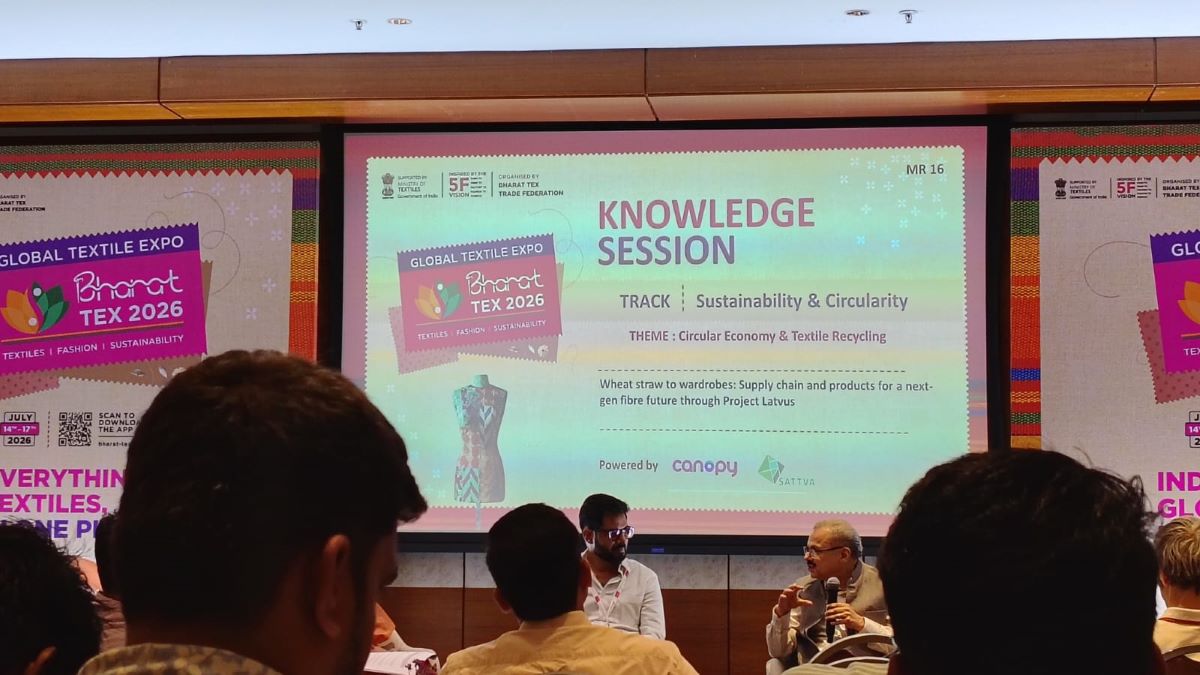
As covered by Salil Chawla, DFU Publications during Bharat Tex 2026 as a delegate.
At Bharat Tex 2026, industry leaders discussed the immense potential of next-generation fibres derived from agricultural residues and dedicated energy crops. With 23 R&D projects underway, at least five feedstocks — including rice straw, bagasse, and dedicated energy crops like Indian Napier grass grown on marginal lands — have shown strong potential for industrial scaling.
Using advanced Chempolis technology, these materials can be converted into high-quality dissolving pulp, paving the way for sustainable man-made cellulosic fibres (MMCF). A landmark 250 kTPA plant is expected to come up in South India by the end of 2026, initially using Napier grass, with bagasse, wheat, and rice straw also viable options. This development promises significant carbon footprint reduction — up to 70% lower Product Carbon Footprint (PCF) compared to conventional fibres.
Brands emphasized three critical factors for scaling adoption: quality parity with virgin materials, supply chain readiness without major process changes, and competitive pricing. While next-gen materials may carry an initial premium, economies of scale and supply chain maturity are expected to achieve cost neutrality within 4-5 years.
Panelists highlighted the need for strong brand commitments, similar to phasing out conventional MMCF and moving towards forest-free alternatives by 2030. Policy support, coordinated investments, and ecosystem collaboration between innovators, fibre manufacturers, mills, and brands were identified as key accelerators. Domestic Indian brands also have a major role to play once local supply chains mature.
Challenges remain around infrastructure, initial economics, and logistics, but the successful pilot-to-product journey demonstrated at the event shows that belief, collaboration, and learning from each project will drive faster adoption.
India is well-positioned to become a global hub for next-gen fibre innovation and supply, contributing meaningfully to sustainable fashion and circular economy goals.

 CONTACT US
