Building a Complete Ecosystem for India’s Sportech Industry
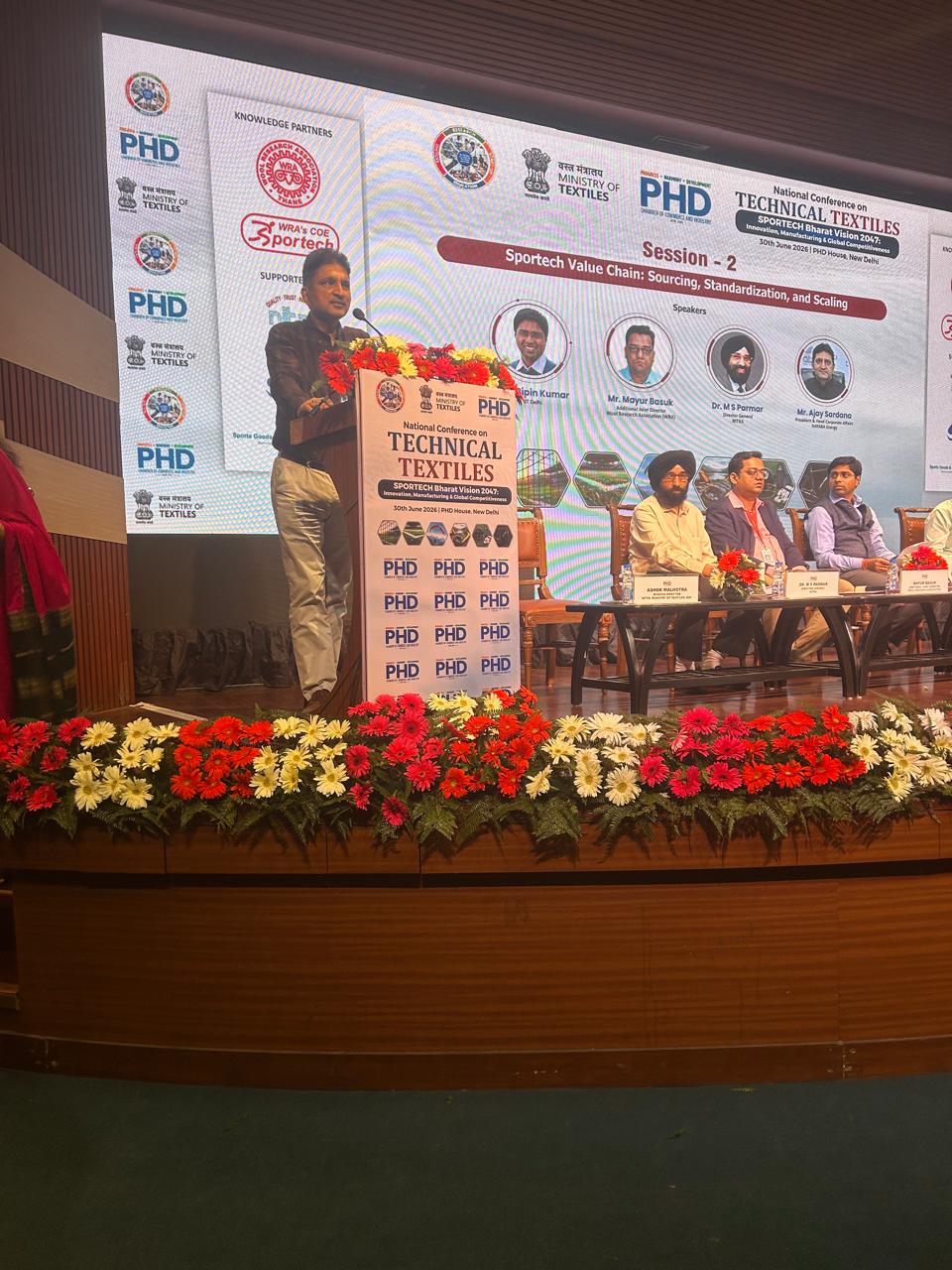
As covered by Salil,Chawla, Director DFU Publications in the capacity of delegate today "National Conference on Technical Textiles" organised by PHDCCI. Excerpts from Ashok Malhotra l Mission Director, NTTM, MoT (Govt of India) address:
Address at the National Conference on Technical Textiles
First of all, let me extend a warm welcome to everyone. I congratulate the PHD Chamber of Commerce and Industry for bringing together all the stakeholders on such an important platform.
When we were growing up, we were always told, “Study first, play later.” Today, the thinking has completely changed. We are now encouraging our children to play first, stay healthy, participate in sports, and then pursue their education. Sports and fitness have become an integral part of life, and this changing mindset is creating entirely new opportunities for the textile industry.
That, in essence, is the significance of today’s conference.
However, for this opportunity to translate into reality, we need to build a complete ecosystem.
An ecosystem today goes far beyond manufacturing alone. It begins with ensuring access to the right raw materials.
No industry can flourish without reliable access to quality raw materials. Whether they are manufactured domestically or imported is a separate issue. But if we want the Sportech industry to grow in India, manufacturers must have access to globally competitive raw materials of consistent quality and at competitive prices.
The journey starts there.
The next question is whether we have clearly defined global standards for these raw materials. Do we know the benchmark specifications required for different sporting applications? Do we have repositories that specify which raw materials should be used for a particular sports garment, performance T-shirt, technical sock, protective equipment, or specialised sports application?
At present, such a comprehensive framework is still evolving in India.
We need to establish globally benchmarked standards and specifications for raw materials that can guide the entire value chain.
At the same time, these standards cannot simply be copied from Europe or other regions.
They must be adapted to Indian conditions.
As Professor Abhijit rightly pointed out, climatic conditions, environmental factors, skin characteristics, and user behaviour differ from country to country. Products designed for European consumers may not necessarily meet Indian requirements.
Therefore, our approach should be to first understand and adopt global best practices and then customise them for Indian conditions. That will create a platform for manufacturing products that are Made in India, Designed for India, and eventually accepted worldwide.
Today, another challenge is that our manufacturing facilities often function in isolation from research institutions.
Research is taking place in laboratories, while manufacturing is happening elsewhere. These two must be connected.
The National Technical Textiles Mission (NTTM) provides an excellent opportunity to bridge this gap. Research should not remain confined to laboratories. Industry partners should be identified from the very beginning so that, once research is completed, technologies can be transferred seamlessly into commercial production.
Research itself also needs a new direction.
For decades, we have largely relied on reverse engineering and adapting products developed elsewhere. That era is changing.
Today, India must innovate its own products.
We must ask fundamental questions:
* What exactly does an Indian athlete require?
* Does the fabric need greater breathability?
* Should it be lighter?
* Should it absorb moisture more efficiently?
* Should it provide better thermal regulation?
* Should it improve comfort or athletic performance?
Innovation must begin with understanding user needs.
Take footwear as an example.
Earlier, shoes were primarily made of leather. Gradually, specialised sports shoes emerged. Today, we have different shoes for running, walking, badminton, trekking, water sports, and numerous other applications.
Even products originally designed for fishermen have evolved into popular lifestyle footwear because of their comfort and functionality.
This illustrates an important lesson: innovation creates entirely new markets.
Similarly, the Sportech industry must bring together every stakeholder.
Sports universities, research institutions, manufacturers, designers, testing laboratories, athletes, and industry must sit together to determine what products India truly needs.
Once prototypes are developed, tested, and validated for Indian conditions, they can eventually be introduced into global markets.
The opportunity before us is enormous.
India’s sports ecosystem is expanding rapidly.
The country is hosting more international sporting events, bidding for major global competitions, and investing heavily in sports infrastructure. This will significantly increase domestic demand for sports apparel, footwear, equipment, and technical textiles.
We must seize this opportunity today rather than wait for tomorrow.
Sportech is not limited to professional athletes.
There is no reason why school uniforms cannot incorporate lightweight, breathable, moisture-managing, and climate-responsive fabrics.
Such innovations can improve comfort for schoolchildren during summer while providing thermal insulation during winter.
The benefits of Sportech can therefore extend far beyond competitive sports.
In reality, almost everyone is part of the sports and fitness ecosystem.
Some people practise yoga every morning.
Others attend Zumba classes.
Many go to gyms, cycling clubs, walking groups, or fitness centres.
They may never compete professionally or win medals, but they require high-performance apparel that supports their daily fitness activities.
This represents an enormous consumer market.
Future research must also focus on integrating electronics with textiles.
Sportech cannot be limited to making cotton fabrics slightly more absorbent or marginally lighter.
The next generation of sportswear must become intelligent.
Imagine a T-shirt capable of continuously monitoring heart rate.
Imagine apparel that alerts the wearer when stress levels become excessive or when hydration is required.
Imagine garments capable of measuring muscle activity, body posture, fatigue levels, or physical performance in real time.
These technologies are entirely possible through the integration of electronics, sensors, conductive yarns, and smart textile systems.
Initially, such products may be relatively expensive.
However, they establish the technological foundation for the future of the industry.
The National Technical Textiles Mission already provides opportunities for research in smart textiles, wearable electronics, and Sportech. These opportunities must now be fully utilised.
Another major objective should be import substitution.
India should focus on developing its own technologies, products, innovations, and manufacturing capabilities.
Once Indian manufacturers begin producing globally competitive products, there will be little reason to depend on imports.
Eventually, international buyers will also begin sourcing these products from India.
Today, Indian brands are certainly emerging in the sportswear segment.
However, one challenge remains.
Often the quality does not yet consistently match leading global brands.
The issue is not a lack of manufacturing capability or skilled manpower.
India has highly capable manufacturers and technically skilled professionals.
The real challenge lies in access to the right quality raw materials.
Let me illustrate this with an example.
Recently, we received a complaint from a manufacturer producing shoe uppers in Agra.
All preliminary testing of the yarn was satisfactory. However, during final fabric production, significant dye streaks appeared in the finished material.
The manufacturer questioned whether the problem originated from the yarn or from the fabric processing.
To verify this, identical production trials were conducted using imported yarn under the same machine settings. The imported yarn produced uniform fabric without streaking, whereas the locally sourced yarn consistently resulted in visible streak defects.
This clearly demonstrated that raw material quality directly influences the quality of the final product.
Manufacturers naturally prefer inputs that enable them to produce world-class products.
Therefore, Indian industry must have reliable access to globally benchmarked raw materials that meet international quality standards.
Manufacturers also have the right to know the benchmark specifications required for different sports applications across the world. Such knowledge should be readily available and supported through appropriate testing, certification, and standardisation systems.
Finally, building a successful Sportech ecosystem requires coordinated efforts across multiple ministries.
The Ministry of Textiles alone cannot achieve this transformation.
The Ministry of Youth Affairs and Sports must provide user requirements.
The Ministry of Electronics and Information Technology can support smart wearable technologies.
The Ministry of Health can help validate healthcare and physiological applications.
The Ministry of Commerce and Industry can facilitate exports and global market access.
When all these ministries work together with industry, research institutions, startups, academia, and sports organisations, India will create a truly integrated Sportech ecosystem.
With such coordinated efforts, I have no doubt that India can achieve the vision of Viksit Bharat 2047—and perhaps even accomplish these goals well before 2047.
That is the opportunity before us, and together we must make it a reality.


 CONTACT US
