Salil Chawla, Director, DFU Publications, covered this annual important event in the NIFT New Delhi is a pioneering institute of fashion education in India.
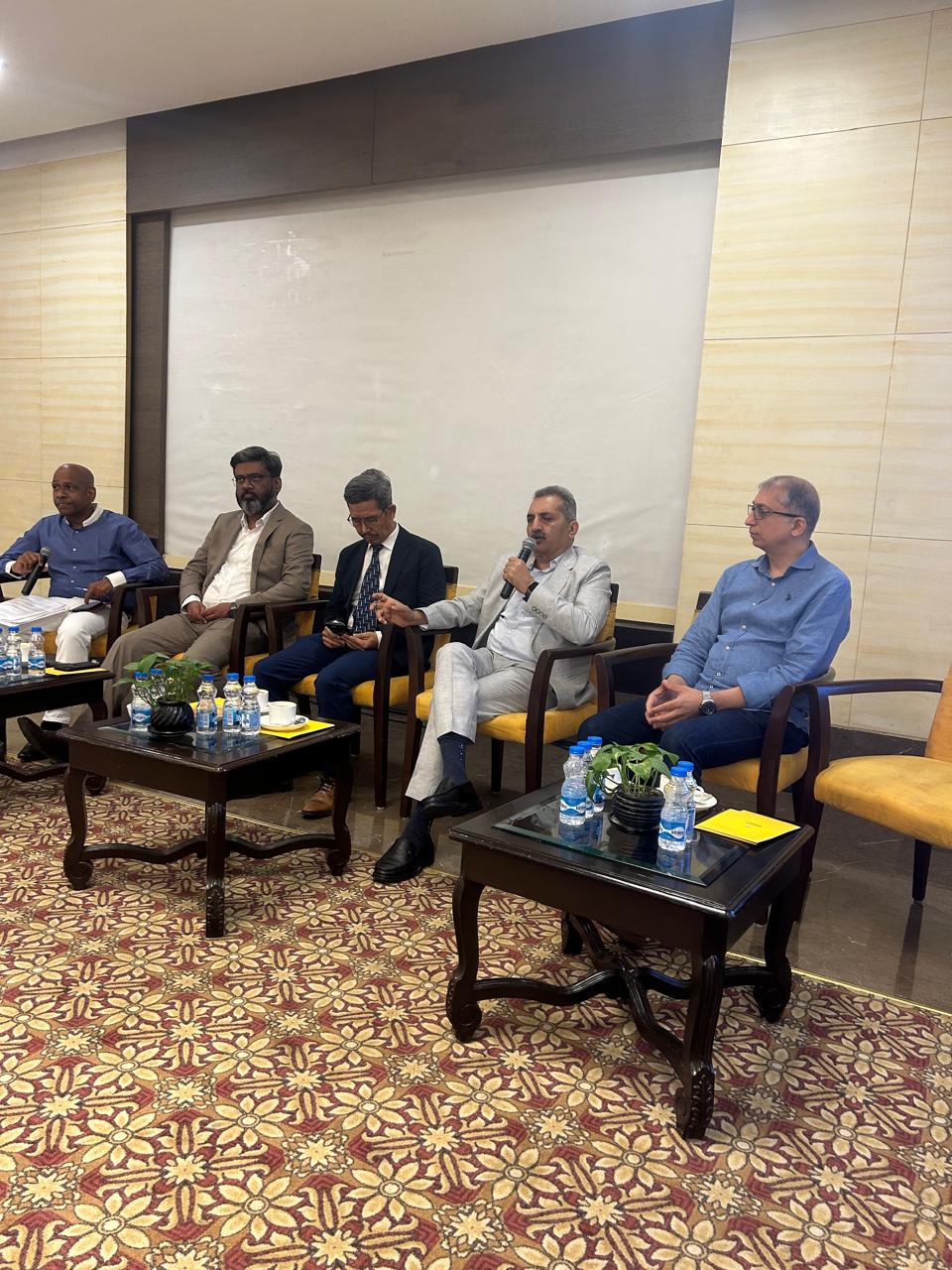
The excerpts of Sanjay Sharma, President & COO, BMD P. Ltd., in an insightful and inspiring conversation as one of the panelists today at Technosummit 2026.
Thank you for giving me the opportunity to be here and express my thoughts on technical textiles. Thank you, Chawla ji. We had a very good discussion related to the industry. Mr. Giri, Shahi Exports who was here, also discussed the strong focus on the production side.
If we talk about technical textiles in the broader context of textiles, I believe we are discussing the scope of technical textiles globally and in relation to Indian technical textiles. So, if we look at the global picture, the total textile industry is close to 1.7 trillion dollars, contributing around 2% to global GDP and about 3% to G&G output. However, technical textiles globally are valued at around 260 billion US dollars, with a growth rate of 3% to 3.5%.
If we look at the major players, China is by far the largest, followed by the United States and Germany, with India also emerging as a prominent player. China is the largest producer and exporter of technical textiles globally, accounting for roughly 24% to 25% of exports.
The United States is the major importer and consumer of technical textiles. In China, the key sub-sectors include biomedical applications such as bandage fabrics, PPEs, masks, and agrotech. These are the areas they are focusing on.
In the US and North America, the major focus is on mobile tech, which includes aerospace, railways, and automotive. Beyond that, the defence sector is another major area where the US and Germany are working strongly. The total export share of the US in technical textiles may be close to 10%, making it the second largest, followed by Germany at roughly 9%.
Coming to India, the technical textile industry is valued at around 27 to 28 billion dollars, and the government has given it significant focus. Recently, I attended a conference where Ashok Malhotra, who heads the National Textile Mission, was present. This sector is being described as a sunrise sector and has been placed under the National Textile Mission.
The growth rate of technical textiles is much higher than that of conventional textiles. While conventional textiles are growing at around 5% to 6% year on year, technical textiles are growing at roughly 12%.
Now, if we look at the sub-sectors, packaging textiles form the main industry and constitute more than 25%, or around a 9 billion dollar packaging segment. Globally, however, almost 50 billion dollars is embedded in this category, which is about 20% to 25% of the total 270 billion dollar market. In India, it is just 7% to 8%, or around 1.7 billion dollars.
I am sure some students here are working in technical textiles, and I would like to ask them why technical textiles, especially mobile tech, are still not widely sold in India. Can anyone answer? It is because we lack the scale and maturity of an experience-driven economy. Indian economy is not yet an experience economy.
Though we are rapidly moving in that direction, luxury travel and aviation are only about a 10-year-old story. We are now the third fastest-growing economy, and automobile and pharma are among the fastest-growing sectors. But per capita ownership, such as cars per thousand people, is still very low compared to the top seven economies. That answers your question. Thank you.”


 CONTACT US
