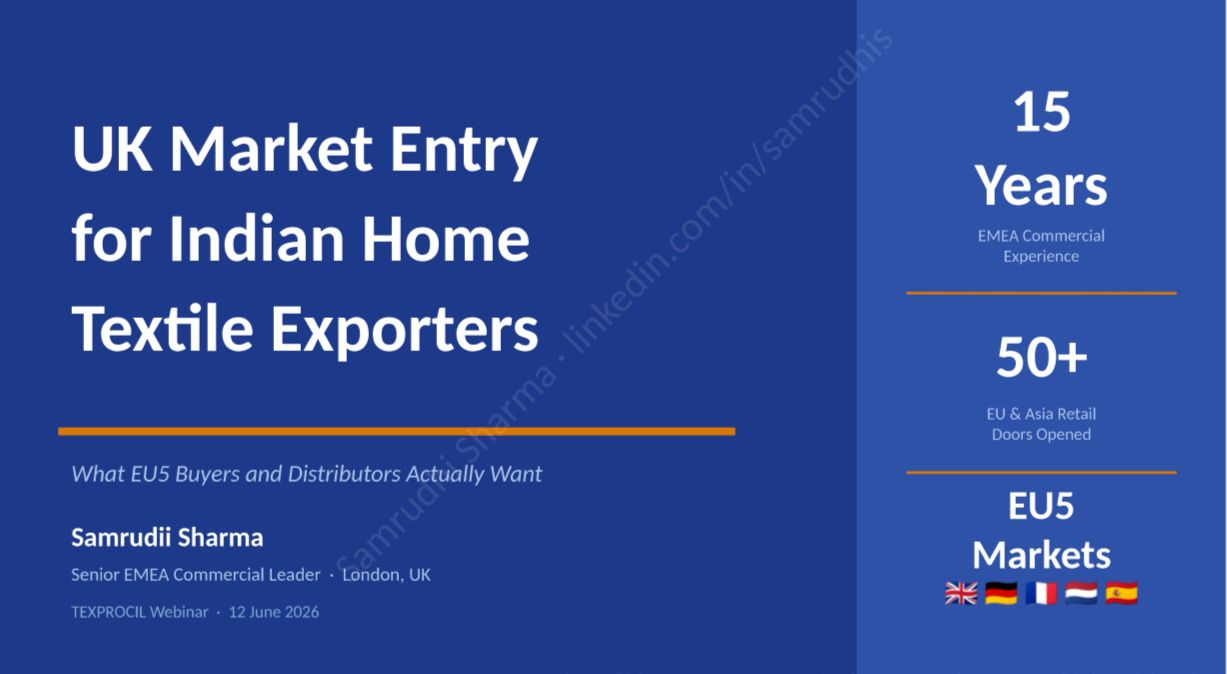
Beyond Tariffs: Winning the UK and European Home Textile Buyer in 2026
The UK and European home textile markets are undergoing a significant transformation, creating fresh opportunities for Indian exporters. While discussions around Free Trade Agreements (FTAs) and tariff reductions often dominate industry conversations, successful market entry today depends on far more than pricing advantages.
The combined home textile market across key European economies and the UK represents a substantial business opportunity. However, buyers are becoming increasingly selective, seeking suppliers who can offer reliability, sustainability, innovation, and category expertise alongside competitive pricing.
European retailers and distributors are actively diversifying their sourcing strategies to reduce dependence on a single geography. This shift has opened doors for Indian manufacturers, particularly in segments such as bath towels, bed linen, kitchen textiles, and premium home furnishing products. India’s strong manufacturing base, vertically integrated supply chains, and growing compliance standards position it favorably in this changing landscape.
Yet, many exporters continue to struggle in converting buyer interest into long-term business relationships. A common challenge is approaching the market as a transactional supplier rather than as a strategic partner. European buyers increasingly value suppliers who understand consumer preferences, support product development, ensure quality consistency, and demonstrate strong environmental and social compliance practices.
Market dynamics also differ significantly across Europe. Consumer expectations, retail structures, pricing strategies, and buying cycles vary between countries such as the UK, Germany, France, Spain, and the Netherlands. Exporters who tailor their approach to individual markets rather than treating Europe as a single destination are more likely to achieve sustainable growth.
For MSMEs, a phased market-entry strategy is often the most effective route. Working initially through wholesalers or distributors can provide valuable market access and insights before progressing toward direct retail relationships or private-label partnerships.
Another critical success factor is understanding margin structures, trading terms, and commercial expectations. Buyers evaluate suppliers not only on product quality and price but also on responsiveness, communication, inventory management, and the ability to support long-term business objectives.
As global sourcing patterns continue to evolve, Indian home textile manufacturers have a unique opportunity to strengthen their presence across the UK and Europe. Those that combine manufacturing excellence with market understanding, brand-building capabilities, and customer-centric partnerships will be best positioned to capture growth in the new trade environment.
Credits: The piece of information has been captured by by Salil Chawla, Director, DFU Publication, in his capacity as a delegate/participant and is based on PPT received out of Ramitha Shetty



 CONTACT US
