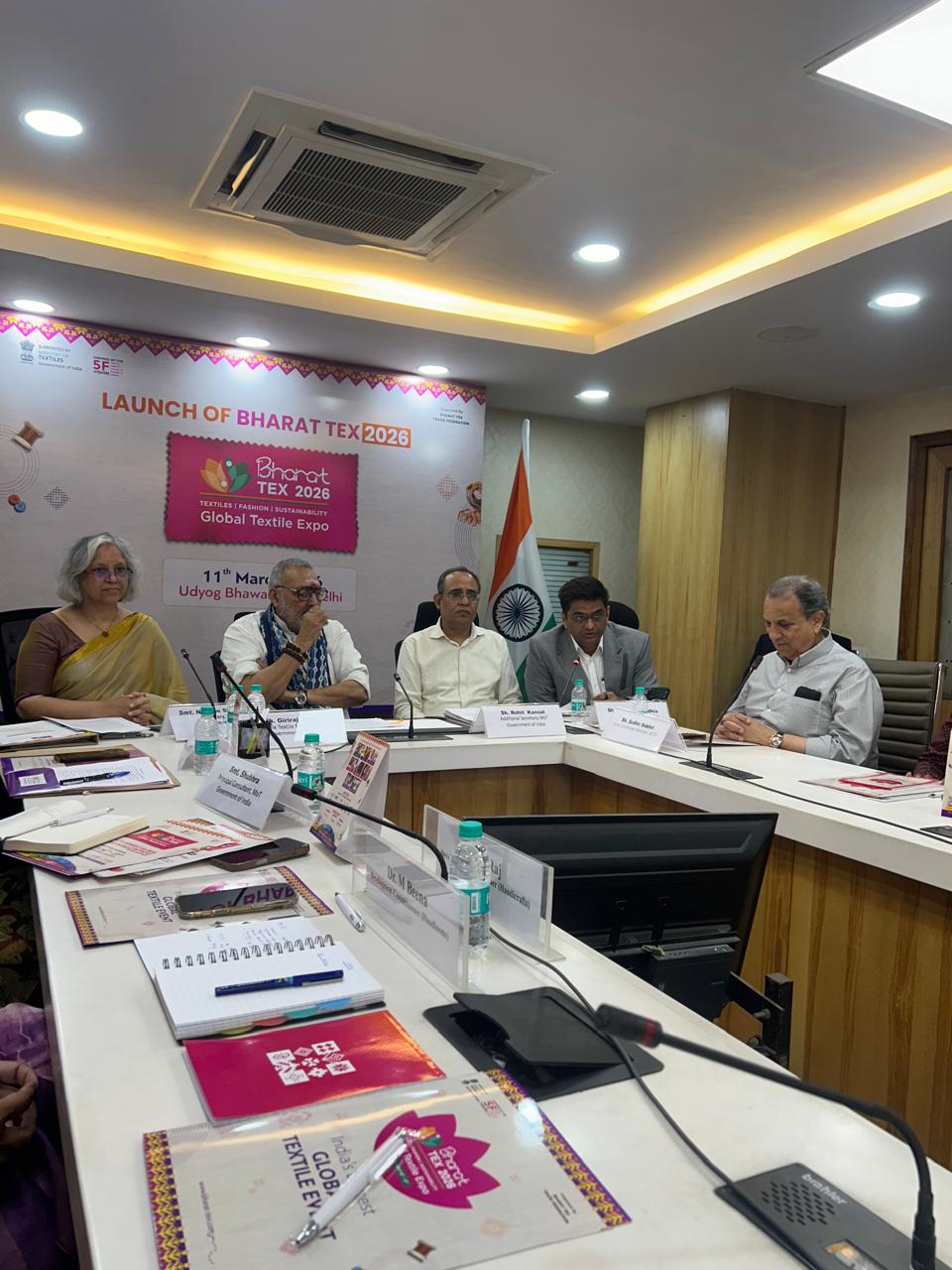
Salil Chawla, Director of DFU Publications, covered the Bharat Tex 2026 launch on March 11, 2026, featuring excerpts from H'ble Textiles Minister Giriraj Singh, Government of India.
I would like to thank the committee, the Additional Secretary, and the entire team. When there was a little imbalance in the middle, our team was as restless as yours. Today, I can say that Bharat Tex has seen unprecedented growth over the last 24-25 months—whether in exhibitors or participating countries, the numbers have jumped from 111 to 141, or even could have been 100.
There were 20,000 products, about 9,900 total buyers (including over 6,800 foreign buyers, of which around 3,000 were new, as per reports from 2024). Visitors numbered 100,000 to 125,000, with 8,000 B2B meetings (no prior benchmarks). Exhibition area expanded from 20-22 lakhs sq. ft., knowledge sessions from 50-70 to this time's 20-40, and partners from 15-20.
Sponsors jumped from 8-9, with new grades added—you even introduce one more beyond the original three, as many requested (not naming Sudhirji, but taking your feelings into account). This has benefited industry protection and exports. Today, we're targeting a $465 billion market amid FTA processes—doubled from $220 billion.
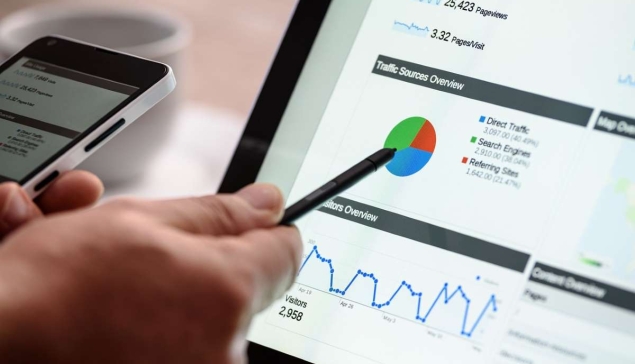
My desire is that for the next 4 months of exports, we deploy specialized people for 8 months—I pray to all of you. Some teams have already used technology and AI, but in the next phase, Bharat Tex must be fully AI-connected: an AI-powered business matchmaking platform linking global buyers directly to the right companies with mind-map backups; an AI chat assistant for easy installation, protection, and system info; a data analytics dashboard showing buyer interests, new export leads, and footfall (e.g., how many visited which stall and converted to buyers); AI translation tools for real-time communication in any language—from Bhojpuri to Japanese—with international buyers. Communication is key; sometimes we miss showcasing quality.
You're more intelligent than us—why run such big industries? Mr. Darji's team is huge, and this time they'll sponsor at A+ grade (tagging them beyond A, B, C, D). On this occasion, I thank Narendra Modi Ji again. Once, I felt the department was overly involved for 6 months, stalling progress—business and industry should lead, with the department in an advisory role. That's my request.
The textile ecosystem's core demands—like QCO, PET, MEG, base-cost, 6-month cotton availability—aren't new; demands grow daily, but basics waited years. I request Rakesh ji especially: better connect handlooms. New designers are revitalizing it with loom designs and tech-captured fabrics—we don't even track which cloths are made where globally. By next time, handlooms will shine anew, with every cloth tech-tagged. From 2014 exports, schemes favored semi-handlooms over real ones (department corrected it); advance authorization was fixed too—right decisions for industry, as Rohit ji noted.
The happiest part: PM Mitra Parks boost platforms for roadshows. We're weakest on machines—India imported 33 lakh swing machines pre-Modi; now over 2 crore.
This isn't my platform; it's trade's, with your cooperation (e.g., recycled fibres that even handle cow dung/manure). The textile ecosystem we showcase combats global environmental chaos.
But India continues to be a bright spot in the challenging business environment.
 CONTACT US
